Seven Free Entries, Two Billing Shapes: Free Row Says on AI API
Two different zeros and one missing zero, and all seven are legitimately described as free. That is worth an article because the difference decides what a cost model can do with the row, and because “free AI API” is one of the most-searched phrases in this market.
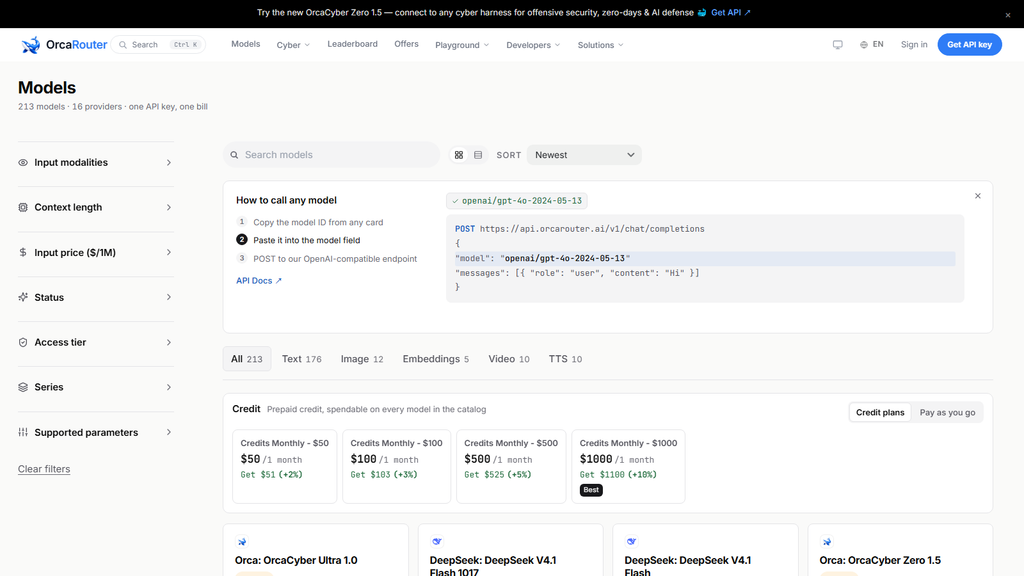
Seven identifiers in the OrcaRouter AI API catalogue carry “free” in their name, and their price records do not all say the same thing [OURS, catalogue read 2026-10-21].
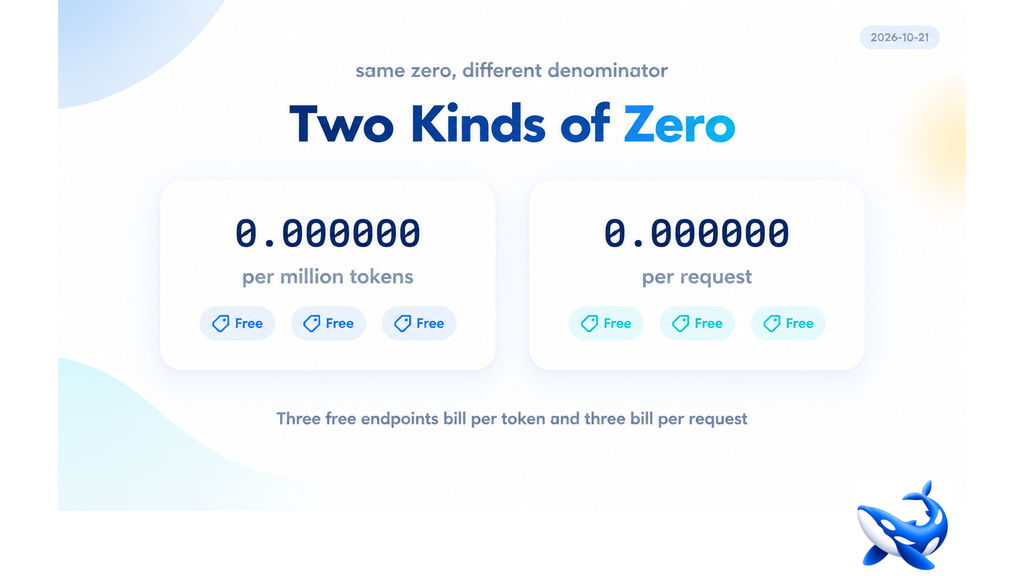
Three bill per token at zero. `deepseek/deepseek-v4.1-flash-free` and `orca/orcaverify-text1.0-free` are the two clear cases: both carry an explicit prompt-and-completion price of `0.0000000000` with a per-million figure of `0.000000` beside it [OURS]. A third token-zero entry appears in the list under a family name rather than a standalone free id.
Three bill per request at zero. `deepseek/deepseek-v4-flash-free`, `tencent/hy3-free`, `tencent/hy4-preview-free` and `z-ai/glm-5.3-flash-free` each carry a single field, `request: 0.000000` [OURS].
And one — `orcarouter/free` — carries no price record at all.
What each shape implies?
A per-token zero is a rate. It enters a spreadsheet in the same column as every other per-token price and produces zero at any volume. A model priced per token at zero is free no matter how much you send, and it composes with input and output splits, cache discounts and everything else a token rate touches.
A per-request zero is a charge. It also produces zero at any volume, but it does not enter a per-token calculation at all: there is no input side, no output side and no cache. Prepaid WiFi Session A workload planner that multiplies tokens by a rate has nothing to multiply.
The distinction rarely matters while both are zero. It matters the moment either changes — a per-token free tier that starts charging scales with your traffic, and a per-request one that starts charging is a flat fee per call. It also matters for everything downstream of the price: a per-request row has no cached-input discount to apply, no output ratio to reason about and no token budget to size.
The seventh row
`orcarouter/free` has neither shape: its record carries a name, an owner and a list of supported endpoint types, and no pricing object at all [OURS].
That is a third case, and it is easiest to read as a routing alias rather than a model — the gateway’s own free slot, which may resolve to whatever the free tier is serving. The catalogue does not say which. What it does say is that the identifier accepts openai, openai-response, anthropic and gemini request shapes, which is more endpoint coverage than any other free entry lists.
An identifier with no price record is not the same as an identifier priced at zero. One has a rate of zero; the other has no rate. Both will look alike to a client that reads “free” from the name.
What the four token-priced zeros actually are
Two of the four are recognisable models with paid siblings.
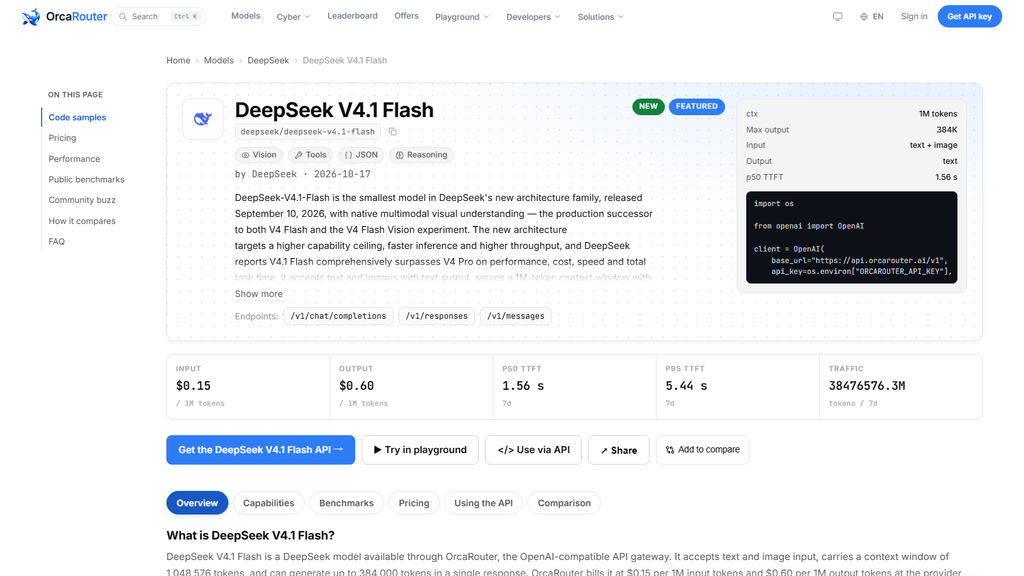
`deepseek/deepseek-v4.1-flash-free` is the free form of a model that otherwise bills at $0.150 input, $0.600 output, $0.0030 cached [VENDOR rates, OURS catalogue]. The paid version carries a 1M context, a 384K output ceiling and a quality score of 8.
`deepseek/deepseek-v4-flash-free` is the request-billed sibling of the older Flash model, which bills at $0.220/$0.660/$0.0070 when paid.
That pairing — a free entry beside a paid entry with the same family name — is the honest way to read a free tier. The free row is a trial of a specific product, and the paid row underneath it is what the trial converts into. The conversion rate is measurable: a caching workload on the paid row at $0.150/$0.600 is cheap enough that the step from trial to production is small.
`orca/orcaverify-text1.0-free` is different in kind: it is the free form of the gateway’s own text-detection endpoint, priced at $0.000 per token on both sides. Its paid sibling is not on the public list, which makes it a free product rather than a trial of one.
The remaining token-priced zero is a Tencent or Z.ai entry depending on how the catalogue is read; the point stands either way — the free entry sits in a family that has a paid rate card.
The three request-priced zeros
These are the rows that will not fit a token budget.
`tencent/hy4-preview-free` is the free form of a preview model with a 1M context and an output ceiling well above a typical generation. `z-ai/glm-5.3-flash-free` is the free form of a Flash-tier GLM with a 1M context and a 128K output ceiling. `deepseek/deepseek-v4-flash-free` is the free form of the older Flash.
All three carry dashes in the cached-input column and none has a per-token price, because the whole billing model is per call. A team building a cost model has to put them in a separate tab, and a team building a rate comparison has to exclude them.
That is not a flaw in the catalogue; it is what a per-request product looks like when it is listed beside per-token products. The rows are shaped differently because the products are.
Why a free tier is a product decision, not a discount
The four families that carry a free entry have something in common: each is a model that competes on price already. A free tier on a $0.150 model costs the provider a small amount per call and removes the buyer’s main objection; a free tier on a $30 model would be a different proposition entirely.
That is why the free row and the paid row are usually adjacent in the catalogue rather than scattered. The free entry is the top of a funnel whose bottom is a row the buyer can afford, and the funnel works because the step is small.
For a buyer, the practical reading is the reverse: a free tier tells you what the provider thinks its cheapest viable product is. On this catalogue that is a $0.15 Flash model and a couple of Tencent and Z.ai previews — not the flagships.
How to use a free entry
Four rules.
Check the record, not the name. Three free entries price explicitly per token, three price per request, and one has no price record at all. All seven are named free.
Pair each free entry with its paid sibling. The sibling is what the trial converts into, and its rate is the number that belongs in a forecast.
Do not put a per-request entry in a token model. It has no input side, no output side and no cache, and every formula in a token budget will either error or silently produce a wrong number.
Re-read the list rather than trusting a note. Free identifiers appear and disappear, and the record carries the authoritative shape. The catalogue is a live list, not a document.
A catalogue that lists seven free entries in two billing shapes and one with no price at all is telling you something useful about how freedom is sold here: as a rate of zero, as a charge of zero, and occasionally as a name with no number behind it.
Sourcing note: the seven free identifiers, their price records and the shape of each record are read from the public model list endpoint on 2026-10-21 [OURS]. The paid sibling rates quoted — $0.150/$0.600/$0.0030 and $0.220/$0.660/$0.0070 — are the provider’s published prices passed through with $0 markup, read from our own provider page the same day [VENDOR]. The 1M context and 384K output ceiling are our own catalogue data. The 0-to-10 quality scores, where mentioned, are our own composite. No third-party figures are used. Free tiers and rates change; all values checked 2026-10-21.